Showing posts with label Germany. Show all posts

Sunday, March 3, 2013

The "How are you?" Code

Bad means "Bath" in German
I really love language. Learning a foreign language is like an expedition: full of long stretches, bumpy roads, and the occasional sharp turn and light at the end of the tunnel. It opens up a whole new world in terms of the people you can interact with and what you have access to within a culture. Discovering these little cultural tidbits is what makes it so much fun. Like when I found out the French call chopsticks "baguettes" or when I realized that the pastry we call an "elephant ear" in the US is called a "pig's ear" here (Germans and their pork!). Understanding how people speak helps you understand how they think, act, and interact, and also what is important to them. 

Being "multicultural" in Poland

Let's ponder how Americans say hello, for example. It is extremely commonplace in the US to throw out a "how are you?" with your "hello" without a second thought- meaning it is completely acceptable, and even expected, that you pose this "question" when just strolling by someone without any time or inclination to stop and actually hear the answer. Sometimes "how are you" even replaces "hello" altogether. A typical response to this question would be: good, ok, great, fine, not bad, or even just a smile and/or nod and no verbal response at all.

A German play on English words
I can't tell you how many times my German mother has brought this up and talked about how impolite it is. If someone asks you the question, why wouldn't they wait to hear the answer? I was talking to one of my closer German friends in Berlin about this the other day and she almost fell off the couch in disbelief. Steam was coming out of her ears she was so worked up. "What if I lost my job? Or have cancer?" she argued, "Am I just supposed to say "fine" in response?"

It's nice that YOU exist!
Yes, that's exactly what you would do if an American you're not close with greeted you and posed this seemingly innocent question. For us it's just routine, and it's most certainly not impolite. It's part of the greeting, basically joined to "hello" so much so that not asking is almost impolite. It feels like you have cut yourself off halfway through the greeting. In return, not responding how you are actually feeling (giving one of the standard aforementioned one-word responses like "fine") is how one is reciprocally polite. Unless it is your good friend, or you're sitting down with someone to chat, you don't bother that other person with what is actually going on in your life. Americans know when a "how are you?" is posed expecting an answer or not. A lot of it comes from the intonation. "Hi! How are you!?" said with a broad smile by someone strolling by is very different from, "So, how are you?" It's subtle, but any American hears the distinction.

"Now I'm going to rub you with a really nice olive oil, garlic, basil marinade"
"Are you really a masseur?"
Different cultures have different codes, and understanding the language helps you access that code. When you think about the difference between how Germans and Americans greet each other, you also see parallels with how they frame their relationships. Germans respond to that question when asked because they know the person is only asking because they expect (and want) a response. Just like there is no pretense of being "friends" with someone you are not actually friends with. Like that same German friend said to me, "You know when someone doesn't like you here." You're not expected to love everyone, invite everyone everywhere, and make friendly all the time. We do a lot more of that in the US, but I wouldn't say it's because we want or feel we have to be fake. We just have a different code for interacting with strangers and acquaintances. The line between "acquaintance" and "friend" is much wider and bolder here in Germany which makes things clearer, but it also makes it harder to break through and make contact with people in the earlier stages of a relationship. In the US there are more levels of friendship than in Germany, and there's a big difference between your friend from yoga class and your friend that you've had since freshman year of college. We may use the same word, but from the context, you can gather the significance of that relationship.

Monday, February 25, 2013

Great Expectations

Lausanne, July
The other week a colleague jokingly said it was cute I was "stressed" about a presentation I was giving in the office, and that it was very "American" of me to put in so much effort. My brain, as always, jumped to the underlying cultural implications of such a statement. Do we Americans tend to be perfectionists and put lots of effort into every little thing (at least in a professional sense)? And if so, why? Is it because we're worried about how we will look in front of others or because success is heavily valued in our society? Or because striving to be "better" and ascending the ranks in some form is part of our Puritan, ambitious, self-starting work ethic?

Colleague's husband's art in Tel Aviv, October
That may play a role, but I also have a hunch that this cultural difference is due in part to educational structure and expectations. In Germany, it's all about credentials. Not "what school did you go to?" (no Ivy League here), but more "what exact training did you receive and what exact certificates do you have?" If you have the certificate, you're expected to know a certain standardized body of knowledge that others outside the field don't have. If you don't have the certificate, well, it's not your field so why should you? Part of this must stem from the fact that people choose an academic or job training path so much earlier here than we are forced to in the States, where spending half of college earning liberal arts credits before choosing a major is the norm. Let alone the number of us who end up doing jobs after college that barely relate to our degree.

Kreuzberg, January
In Germany, life planning is notably more direct: you're filtered into a school level by age 10 that determines whether you will go to college or into a vocational path, and before entering higher education you most certainly have picked a major. That area becomes your expertise and if you want to do something else, you basically start over from scratch to get all those required certificates for that new field. Even applying to university is a more no-nonsense game over here. It's not about how many extracurriculars you did, what type of personality you have, or where you see yourself in 10 years. It's your grades and your planned field of study, that's it. This system is too rigid- 10 years old is way too early to filter, tracking puts lower-income students at a disadvantage, and the 21st century requires a more flexible skill set- but I can't deny it has its advantages, too. People are highly trained and generally competent in their fields. In the US on the other hand, the typical liberal arts college is designed to give you a well-rounded and general skill set (learning how to write and do research, learning to work well with others, etc.) and subsequently a lot of training ends up happening "on the job."

Tiergarten, February
My colleague summed it up this way: Germans plan and Americans prepare. And I think there's some truth to that. If you're well-trained for a job, you may not feel the need to do a lot of "last minute" preparation because you've been preparing for, oh, 10 years. And maybe, if I'm allowed to push it this far, the higher level of job security in Germany may make pushing yourself to the brink or outshining the others less of an issue. In a similar vein, my American friends and I have talked about how unusual it is to hear praise from teachers or bosses here. While in the US you may get a "great job!" for sorting the mail correctly, in Germany you may receive no positive feedback after a 30 minute presentation that you put hours of work into. Both situations can seem a bit ridiculous (and counterproductive) at times.

Köln, February
I would probably be more confident in my current job had I began training in international education at age 14 or 18 (or even 22 instead of 25), but a great deal of my "training" for this field and the reason I got my job is my soft skills, and those come from a variety of experiences and jobs, not from one certificate. So in typical transnational form, I think both systems have it right and wrong and could stand to learn from one another. A little planning and a little preparation never hurt anyone.  

Tuesday, January 29, 2013

The Case for Food Snobbery

Last dinner in Bethesda with the family
It's no secret that I am a bit of a foodie and eat (and drink) pretty well. Besides travel it's probably the number one thing I splurge on. I blame my family, since growing up with a dad, sister, and aunt who all cook really damn well meant I had high standards from a young age. The travel hasn't helped either, because once you have sushi in Japan or wine in Mendoza or gelato in Rome or seafood in Brittany or chocolate in Switzerland it's hard to go back to the mediocre stuff. I also don't know why being a "food snob" has to have such a derogatory connotation. Smokers have their preferred cigarette brands, no one rolls their eyes when people say Starbucks makes bad coffee, so why is it so bad if I say I'd rather not eat at Olive Garden or Chili's? I'm not going to sneer at anyone who does, I'm just not going to be sitting at the table next to them slurping up overcooked fettuccine drowning in a bath of bland cream sauce.

Galettes with Giovanni (extra egg on top for good measure)
Discovery of a new Weinbar with Kelly in Kreuzberg
I also think food snobbery gets conflated with people just trying to be high-class. I'm not talking about fancy food here, just good quality food. When I lived in smaller towns I ate plenty of "peasant" food like spaetzle and pretzels in Ludwigsburg and Tuebingen and galettes in Lannion, and I loved it. But the problem with living in small European towns like those was that although local cuisine was tasty and of high quality, there was absolutely no diversity. Tuebingen had one mediocre Chinese buffet and Lannion had... a Subway. Thankfully, Berlin is a large capital city with most cuisines on offer, and on top of that it is cheap. Not everyone seems to know that about Berlin. But yes, Berlin is very cheap and you can eat (and drink) pretty well at a reasonable price. So this foodie does! 

My ongoing search for Berlin's best cappuccino at an Italian cafe
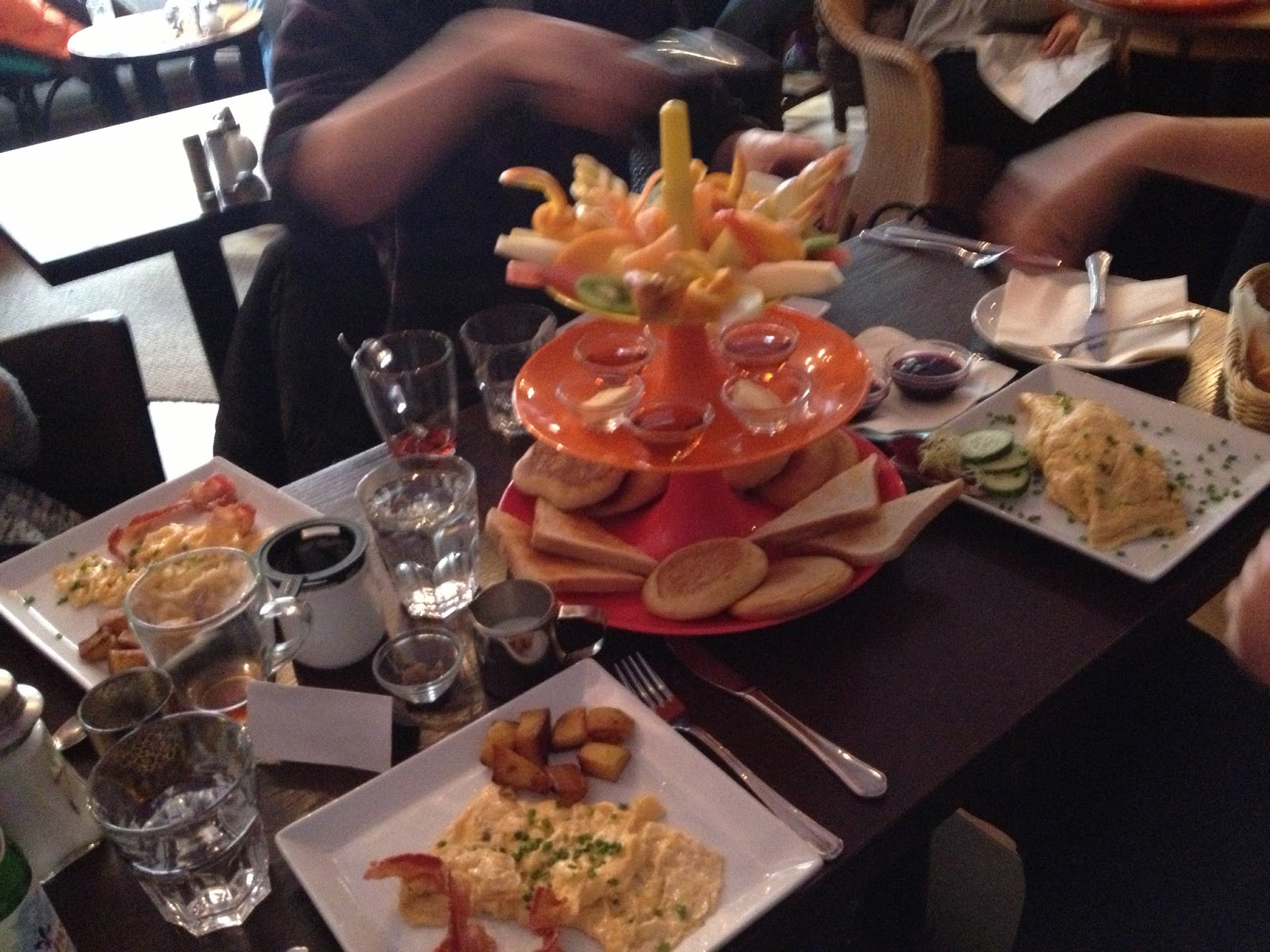
Sunday brunch with Max and Kelly in Prenzlauer Berg
Pizza, salad, and wine night
Chicken curry at "Gruene Woche"

Monday, August 20, 2012

The Big B

Entrance to Katharinenhof
Berlin is, of course, my main B. And it's certainly big, population wise. But geographically, for a state, it's pretty small (did you know Berlin is one of the three cities in Germany that is a city and a state?). The other big B that I am referring to is Brandenburg, a former East German state that surrounds Berlin on all sides. See?


Brandenburg is perhaps most famous for the town of Potsdam, where tourists go to see Friedrich the Great's castles and Schloss Cecilienhof, where the Potsdam Conference was held after World War II. But B-burg has many more "corners" as the Germans say, and many of those corners are pretty rural. On Saturday evening, my friend Keighley and I took the train out to Brandenburg to attend a Hoffest, or farmyard party. Keighley's boss and a few other families co-own the farmhouse and throw this summer shindig every year, and I happily accompanied Keighley as her "plus one." 

Party invitation
The Hoffest took place out in Gransee, a town about an hour train ride from Berlin. Already 15 minutes outside of the city we saw livestock, pastures, and just lots of things you don't see in Berlin. Keighley and I were both starving and started to munch on some chocolate she had brought along and enjoyed the view. Once we got to Gransee her boss picked us up in a really old Jeep-like contraption, drove us a bit through town to show us the requisite main drag and super old church (didn't take long) and then we hobbled up the stone path to the farmhouse. The farmhouse is called Katharinenhof to which I immediately felt an affinity- but only because my middle name is Katharina, not because I am used to farms.


Grazers
I'm really bad at estimating numbers, but there must have been a good 150+ people at the party. And an extremely mixed crowd age-wise. I couldn't remember the last time I saw so many little kids, especially ones free-ranging and shrieking with cake smeared all over their faces. After making three efficient trips to the buffet for goodies like potato and cucumber salad, pasta, bread, cheese, and lots of red wine, we befriended a few other 20-somethings who were kind enough to share their blanket with us. A bunch of people had also set up tents because they planned to stay the night, but (not so) unfortunately, we weren't able to find ourselves one in time. (Shhh, I'm not much of a camper.)

Party Campers
Dance room
In the backyard they had a huge screen set up that played Jungle Book for the little ones (dubbed in German which was interesting), and then a movie they had created about the Hof which is about to celebrate its 100 year anniversary. The Hof was originally owned by two Jewish sisters in 1912 who grew fruit that was shipped and sold in Berlin. The sisters were later deported to a concentration camp, and in one part of the video, their now elderly niece talked a bit about her memories of her aunts and summers on the Hof. The rest of the video showed the young kids who now spend their summers there (probably the same ones who drew the invitation), jumping across bales of hay, exploring dark corners of the house with flashlights, and screaming in delight at bugs and strange noises. Made me think of my summers in the mountains in France with my sister and cousins: exploring the forest, picking blueberries, and splashing about in our nearby "Dream Stream."  

Keighley and I
Once it got dark, we were able to look up and see the enormous sky speckled with stars, and man, that stirs something inside of you if you don't see it often. At one point we may have even seen a shooting star. That, or a realllly small airplane. Not that this city girl would know the difference. 


Saturday, August 18, 2012

Gesehen: Back to School

Storefront window
It's back to school time in Berlin, right as our "summer" here is really beginning, at least weather-wise. This kids clothing storefront window says "We wish all schoolkids a successful beginning of the year." The cone shaped bag that the kids in the drawing are holding is called a Schultuete or Zuckertuete (schoolbag or sugarbag) that kids get on their first day of the first grade, full of goodies like chocolates and candies. That's one way to get kids to like school!

Thursday, July 12, 2012

Sad Schland and their Soccer

Spotted morning after the loss to Italy
When Germany lost to Italy in the Euro Cup Halbfinale a few weeks ago, one of my American friends who hates soccer sneered, "Well good, let someone else in Europe win at something for once." I'll admit a teensy (teensy!) part of me wanted Greece to beat Germany in an earlier game, but I love Germany during soccer tournaments, and honestly, I think they deserve any and all soccer success and more importantly, all the excitement that goes along with it.

Pringooooooals
Not all German snacks are American
Here's why. Germany has a dark, horrid, and painful history, and as a result, is very averse to signs of patriotism. Insert requisite comment about them deserving it entirely. Soccer is the one safe outlet Germans have to put up flags, eat patriotic snacks, and cheer for their fellow countrymen- what Americans do every freaking day.  So yeah, it warms my heart to see cars with those red, black, and gold covered rear-view mirrors and baby flags and people wearing jerseys and screaming "Schland!" and "Schweinsteiger!" Oh wait, that last part was just Daniel.

This is about as intense as it gets
Watching the game from a Thai restaurant
Another thing I like is that game viewing is such a public affair here. In the US, sports viewing seems somewhat private. Especially big games like the Superbowl, which people tend to exclusively watch at home with friends and family.  (I'm sure public drinking laws play a large role here.) The Euro Cup in Germany was like an extended outdoor party. Berlin's immense amount of bars and restaurants with outdoor seating were packed with people for every game. Not to mention the "Fan Mile" by the Brandenburg Gate.

Euro Cup eggs
"Fan Mile" for public viewing
But man, even after a goal (and lots of beer) the cheering is pretty subdued compared to American standards. So I ask you to let the Germans have their soccer. They need it.

Friday, June 15, 2012

Week One

View from the balcony in my office
Lessons learned from my first week working in a German office. It's not scientific, but in 5 days I have garnered it is acceptable to:

1) Wear jeans all week long.

2) Arrive around 9:30/10am.

2) Dip out of work a little early to watch a big soccer match.

3) Take lots and lots of breaks if you are a smoker. They may end up with shorter lives in the end, but they're making the time they've got count.

4) Leave when you feel you hit your limit for the day (within reason of course- I'm not talking 3pm here- unless it's a Friday). "What are you going to do instead, sit there and pretend to work?" scoffed one coworker. Um yes, that's exactly what we Americans do.

5) Leave in the early afternoon on a Friday.  Freitag ab eins, macht jeder seins goes the saying. Translation: Starting at 1pm on Friday everyone does their own thing.

6) Take 25 vacation days a year. HA. I just threw that one in to piss you off. 

I guess I've made it all sound pretty great. So here are some downsides to even things out a bit:

1) If you don't go to the Finance Bureau and sort out your tax class you are automatically placed in Class 6 where they deduct, oh, approximately 80% of your salary. I'm all for social welfare but 50% seems like plenty, thankyouverymuch.

2) The whole welcoming someone new to the office with a happy hour, lunch, cupcakes, or uh, email to tell them how they're going to get into the building their first day is apparently not protocol.

3) You have to type on a German keyboard with US settings for a week. But that's likely just in my case. Hyphens, colons, and quotation marks, where are youuu? Umlauts go awayyy.

Thursday, January 12, 2012

Warming the House with Brunch and Glühwein

Shortly before heading back to DC for Christmas, I had some Berlin friends over to the apartment for the first time for a makeshift housewarming party. I hosted a brunch, partly because I think brunch is an easy meal to host and partly because I don't know if I'm ready to risk an evening party in my building where the mean age is 72 and the mean bedtime 8pm.

There were 6 of us in total and we spent a couple hours lounging around, sipping mimosas, and eating entirely too much food since I had decided to cook for an army. Among other things, I made some Algerian felfel and for the next 4 days was hit with the smell of roasted peppers and garlic when I entered the apartment.

After brunch, 3 of us decided to check out the Schloss Charlottenburg Weihnachtsmarkt which is supposed to be one of the nicest in the city. We were not disappointed! The market was beautiful, the lights sparkling, the Glühwein flavors varied. My pictures are unfortunately not of the highest quality because my camera was broken and I had to use my iPad. Which, by the way, is pretty awkward. Whipping out an iPad for a casual picture is not discrete. Still I love my iPad so much, thankyoumomdadjuliazachalexdaniel!

Brunch:

Schloss Charlottenburg Market:

Anna, Kelly, and I enjoying Glühwein of the Bratapfel (baked apple) and Himbeer (raspberry) varieties:

Sunday, December 11, 2011

Die Zeit Läuft Uns Davon

Translation: Time (freakin') flies

April 2006:

December 2011:
From left: Lea, Jan, Lucas, Sophia, Fynn (Schwaderer cousins in Soest)

Friday, December 2, 2011

Yes, that'll be all.

Something I've noticed, and come to appreciate, about Germans is a lack of judgement in the grocery store check-out line. Or at least no visible judgement, nor embarrassment about purchases. My very scientific deduction of this theory consists of watching multiple people check out with only beer bottles, or miniature white wine bottles, in their baskets. At 10am. On a workday. In the US, I feel this would garner some looks. But here, it's no big deal. Just like seeing two guys in work uniforms drinking beers. At 2pm. On the metro. Like I did today.

Upon further reflection, maybe it's because they are often individual bottles instead of 6-packs. With a 6-pack one might think, oh, he might be taking that to a party later. When it's 6 various loose bottles rolling around the conveyor belt I just picture the guy leaving the store, turning a corner, and drinking them all on the street within half an hour. Another factor to consider is that in Germany and Europe in general, people walk to the store and make multiple smaller trips a week than their American counterparts. So to go out just for some beers is really not so strange when you'll be back less than 24 hours later for your bread and milk.

In this spirit of non-judgement, my purchase tonight consisted of two things: a bar of chocolate and a bottle of red wine. I felt I was entitled, considering it is Friday and yesterday's trip to the fruit and veggie stand was much more virtuous.

Cheers!

Photo taken on a trip to Berlin in 2008- the bar I bought tonight was assuredly not the size of my face.